


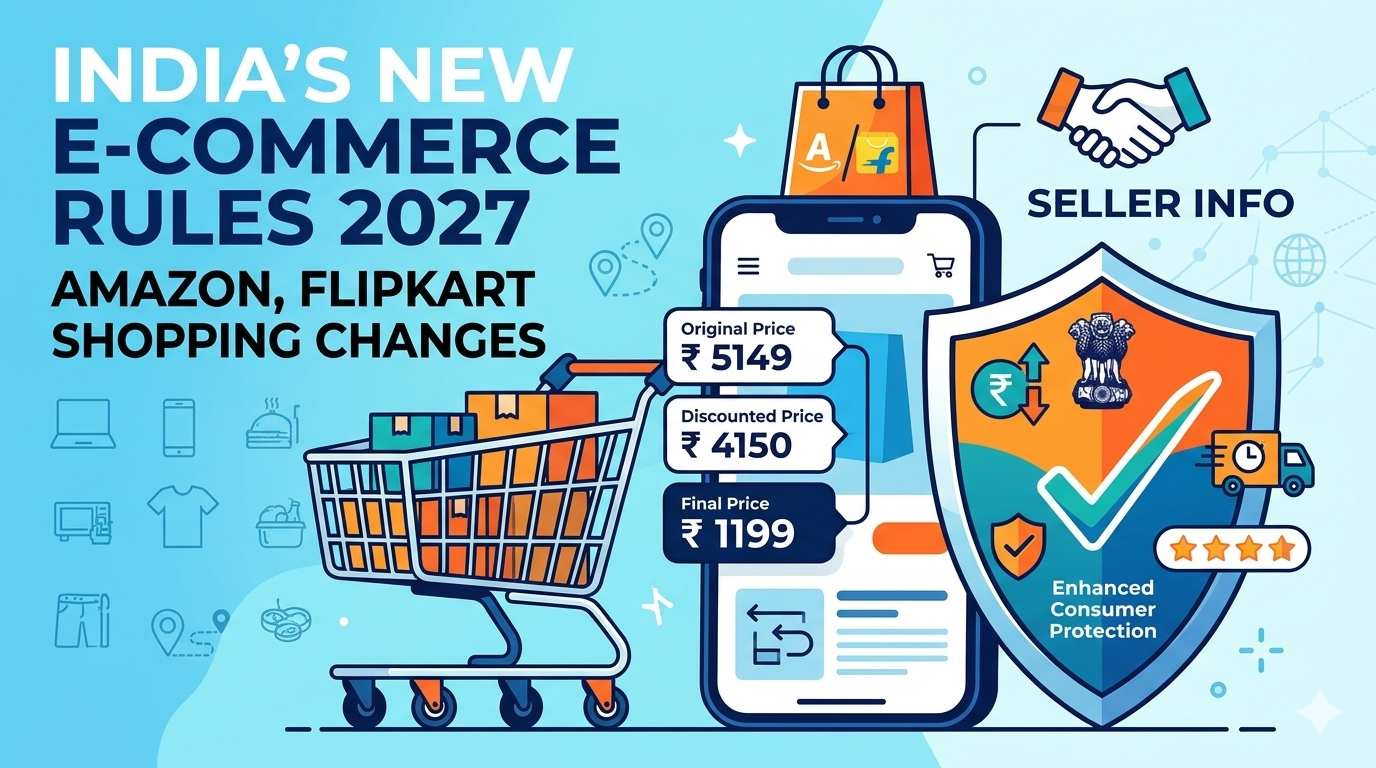
Online shopping in India is set to become more transparent from January 1, 2027, as the Central Government introduces new rules to strengthen consumer protection in the e-commerce sector. The changes are expected to affect how online shopping platforms display discounts, sponsored products, search results, product information and refund policies.
The new regulations will be particularly important for millions of consumers who regularly purchase smartphones, electronics, clothing, household products, groceries and other essential items through platforms such as Amazon, Flipkart and other online marketplaces.
The government has amended the Consumer Protection (E-Commerce) Rules, 2020, through the Consumer Protection (E-Commerce) (Amendment) Rules, 2026. The amendments aim to prevent misleading discount advertisements, improve transparency and make online shopping platforms more accountable to consumers.
According to the government notification, the new E-Commerce Rules will officially come into force on January 1, 2027.
1. Online Shopping Platforms Must Show Genuine Discount Prices
One of the most important changes concerns misleading discount advertisements.
During major online sales, including Diwali sales, festive offers and special shopping events, consumers often see products advertised with discounts of 50%, 60% or even 80%.
However, in some cases, the original price may be increased before a sale, making the advertised discount appear much bigger than the actual price reduction.
Under the new rules, whenever an e-commerce platform announces a price reduction, it must display both the reduced price and the prior price.
The prior price will mean the lowest price at which the product or service was offered during the 30 days preceding the announcement of the discount.
For example:
- A product was available for ₹5,000 during the previous 30 days.
- The seller increases its displayed price to ₹8,000.
- The product is then advertised at ₹4,000 with a 50% discount.
Under the amended rules, the platform must disclose the relevant prior price of ₹5,000 alongside the reduced price of ₹4,000.
This will help consumers understand whether a discount represents a genuine price reduction rather than simply relying on attractive promotional claims.
2. Sponsored Products Must Be Clearly Identified as per new E-Commerce Rules
When consumers search for products on Amazon, Flipkart or other shopping websites, some of the first results may be paid promotional listings.
These products are generally displayed because sellers or brands have paid for advertising or better visibility.
However, consumers may sometimes find it difficult to distinguish sponsored products from regular search results.
The new rules require e-commerce platforms to identify sponsored listings through clear and prominent disclosures.
This means shoppers should be able to recognise when a product is appearing because of paid promotion rather than only its relevance to their search.
It will help consumers make more informed purchasing decisions instead of assuming that the first product displayed is necessarily the best or most suitable option.
3. Search Results Cannot Be Manipulated to Mislead Consumers
Another important amendment addresses the way products appear in online search results.
For example, when a customer searches for a particular smartphone, laptop or household appliance, the platform should provide relevant search results.
The amended rules prohibit e-commerce entities from manipulating search results or search indexes in a manner that misleads users or negatively affects the relevance of results to their search queries.
This provision aims to make product discovery more transparent and prevent misleading search practices. Consumers may therefore benefit from a more relevant shopping experience when comparing products online.
4. Product Details, Warranty and Refund Information Must Be Transparent
Before purchasing a product online, consumers need accurate information about its quality, validity, warranty and after-sales services.
However, incomplete product descriptions and unclear return policies can create difficulties when customers receive damaged, expired or unsuitable products.
Under the amended rules, marketplace e-commerce platforms will have to provide important product and service information to help consumers make informed decisions.
This includes:
- Best-before and use-before dates, wherever applicable.
- Return and refund policy details.
- Warranty information.
- Delivery-related information.
- Payment-related details.
These disclosures will make it easier for customers to understand the terms and conditions before completing their purchases.
5. Stronger Rules for Customer Complaints and Refund Issues
The government has also strengthened the consumer grievance redressal process.
Under the amended rules, e-commerce platforms must ensure that their grievance officers acknowledge consumer complaints within 48 hours.
They must also provide the complainant with a copy of the complaint as recorded by the grievance officer.
Furthermore, the complaint must be redressed within one month from the date of receipt.
Every e-commerce entity will also have to become a partner in the convergence process of the National Consumer Helpline (NCH).
This is an important development because consumers frequently face difficulties when trying to resolve issues related to defective products, delayed deliveries, incorrect orders and refund requests.
The stronger grievance mechanism aims to improve accountability and make complaint resolution more accessible.
6. Imported Products Must Display Country of Origin and Importer Details
Consumers purchasing imported products will also benefit from additional transparency.
Under the amended rules, e-commerce platforms offering imported goods must disclose:
- The name and details of the importer from whom the goods were purchased or who is selling them.
- The complete country of origin of the imported product.
This information will help consumers identify where products come from and understand the businesses involved in their sale.
It will be particularly useful when purchasing imported electronics, accessories, cosmetics, clothing and other international products.
7. E-Commerce Companies Must Take Action Against Dark Patterns
Dark patterns are misleading website or app design practices that influence consumers into making decisions they might not otherwise make.
Some common examples include:
- Creating a false sense of urgency through misleading countdown timers.
- Adding unwanted products or services during checkout.
- Making cancellation or subscription termination unnecessarily difficult.
- Using confusing interfaces to encourage additional purchases.
- Hiding important charges until the final payment stage.
The amended rules require e-commerce entities to comply with the Guidelines for Prevention and Regulation of Dark Patterns, 2023.
They must also conduct an annual self-audit and prominently display a certificate of compliance.
This provision aims to make online shopping interfaces fairer and reduce manipulative practices that can affect purchasing decisions.
8. Better Protection for Consumers’ Personal Information
Online shopping platforms collect different types of customer information, including contact details and shopping preferences.
The amended rules introduce additional safeguards against the use of consumer information for specified purposes without express and affirmative consent.
This means platforms will have to obtain the required consent rather than treating customer information as freely available for every purpose.
The change aims to strengthen consumer control over how their personal information is used.
9. No Unrelated Bundled Charges Without Proper Conditions
Another important change concerns additional charges collected by online marketplaces.
Under the amended rules, marketplace e-commerce entities cannot collect bundled fees for services unrelated to the e-commerce platform, subject to the specified exception for loyalty or membership programmes.
This provision aims to prevent consumers from being charged for unrelated services without appropriate transparency and safeguards.
What Will These New Rules Mean for Amazon and Flipkart Users?
The new regulations are relevant to the wider e-commerce sector and are not limited to Amazon and Flipkart.
Consumers using different online shopping platforms can expect stronger disclosure requirements and improved accountability from January 1, 2027.
Here is a quick overview:
| Shopping-related issue | What changes from January 1, 2027 |
|---|---|
| Discount offers | Reduced price and lowest prior price during the preceding 30 days must be displayed |
| Sponsored products | Clear and prominent sponsored disclosures |
| Search results | Misleading manipulation of search results prohibited |
| Product information | Better disclosure of expiry, warranty, returns and delivery details |
| Consumer complaints | Acknowledgement within 48 hours and redressal within one month |
| Imported products | Importer and country-of-origin details |
| Dark patterns | Annual self-audit and compliance certificate |
| Personal information | Express and affirmative consent for specified uses |
| Additional charges | Restrictions on unrelated bundled fees |
What Should Online Shoppers Do Before Buying Products?
Although the new rules will strengthen consumer protection, shoppers should continue following basic precautions while purchasing products online.
Here are some useful tips:
- Compare prices: Check product prices across different shopping platforms instead of relying only on advertised discounts.
- Check seller ratings: Review seller ratings, customer feedback and product reviews before placing an order.
- Read return policies: Understand the return, replacement and refund conditions before making payment.
- Verify product details: Check specifications, warranty, expiry dates and other relevant information.
- Look for sponsored listings: Do not assume that the first product appearing in search results is necessarily the best option.
- Keep payment records: Save order confirmations, invoices and payment receipts for future reference.
- Raise complaints: If a seller or platform fails to resolve an issue, consumers can use the National Consumer Helpline.
These precautions can help reduce the risk of misleading offers, unsuitable purchases and online shopping disputes.
Conclusion
The new E-Commerce Rules 2026 represent an important step towards improving transparency and consumer protection in India’s rapidly growing online shopping industry.
From genuine discount disclosures and clearly identified sponsored products to better refund information and stronger complaint-handling procedures, the amendments address several issues that consumers regularly encounter while shopping online.
For customers using Amazon, Flipkart and other e-commerce platforms, the changes could make it easier to compare prices, understand product information and raise complaints when something goes wrong.
However, consumers should remember that these rules do not guarantee that every product will be cheaper or that every refund will be automatic. Their primary objective is to ensure greater transparency, accountability and fair practices in online shopping.
The new Consumer Protection (E-Commerce) (Amendment) Rules, 2026 will come into effect across India from January 1, 2027.
Watch Latest News Videos on KRH News: Click Here