


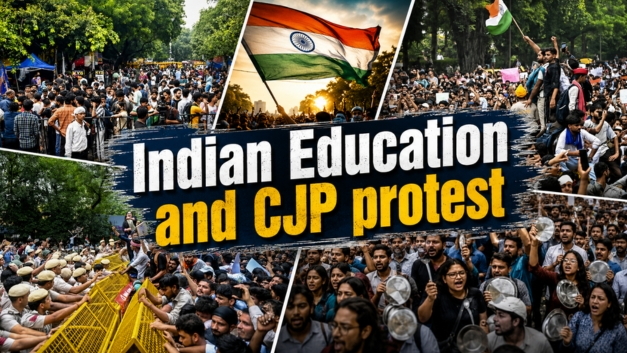
CJP Jantar Mantar Protest: Demonstrators, students, and youth activists continue to occupy the historic grounds of Jantar Mantar in the national capital. What began as a youth movement against systemic examination failures has transformed into one of the most intense student-led agitations in recent Indian history.
Spearheaded by the youth-led Cockroach Janta Party (CJP) alongside major student unions, the ongoing demonstrations at Jantar Mantar highlight deep structural flaws within the Indian competitive exam ecosystem. With the NEET-UG 2026 paper leak scandal and widespread CBSE revaluation irregularities driving nationwide outrage, the protest has captured the national spotlight and drawn direct involvement from top political leaders.
Ground Reality: What Happened at Jantar Mantar?
The situation at Jantar Mantar escalated dramatically following the CJP’s “Sansad Chalo” (March to Parliament). Over 100,000 students and young citizens gathered in Central Delhi, demanding direct legislative intervention and institutional accountability.
Security measures across New Delhi remain exceptionally tight, with heavy police barricading near Rafi Marg and Parliament House, alongside temporary metro station closures. Despite police action, tear gas deployment, and stage dismantlements earlier in the week, student protesters successfully reclaimed the Jantar Mantar site to maintain their sit-in.
Key Demands Raised by the Cockroach Janta Party (CJP)
The CJP leadership, led by founder Abhijeet Dipke and representatives Sourav Das and Ashutosh Ranka, has outlined non-negotiable core demands to clean up India’s testing ecosystem:
- Resignation of the Union Education Minister: Direct political accountability from Union Education Minister Dharmendra Pradhan regarding public examination leaks.
- Compensation for Affected Families: Financial relief of ₹1 crore for families of aspirants who died by suicide due to stress and uncertainty surrounding exam cancellations and leaks.
- Statutory Anti-Leak Oversight Body: Establishment of an independent, multi-stakeholder regulatory commission overseeing national testing agencies.
- Immediate Release & Medical Protection for Fasting Activists: Ensuring health protections for activist Sonam Wangchuk, who was shifted to Medanta Hospital during his fast in support of the students.
- Abolition of Flawed Evaluation Protocols: Overhauling digital and on-screen evaluation methods used by secondary education boards to prevent grade discrepancies.
Political Escalation: Sit-Ins and High-Security Detentions for CJP Jantar Mantar Protest
The CJP agitation at Jantar Mantar has sparked political friction in the halls of power. In a show of solidarity with the protesting students, Leader of Opposition Rahul Gandhi, Congress MP Priyanka Gandhi Vadra, and Samajwadi Party Chief Akhilesh Yadav staged an impromptu sit-in outside Prime Minister Narendra Modi’s official residence.
“An attack on students is an attack on every Indian family. PM Modi believes he can get away without answers, without consequences. He cannot. Not this time.”
— Rahul Gandhi, Leader of Opposition in the Lok Sabha
The high-stakes standoff led to the temporary detention of senior Opposition leaders before their release. Meanwhile, Union Health Minister J.P. Nadda and MoS PMO Jitendra Singh indicated a willingness to engage in official talks with CJP delegates at a neutral venue to resolve the deadlock.
Why the Indian Education System Needs Urgent Structural Reform
The crisis driving the CJP protest at Jantar Mantar is not an isolated incident; it represents a breaking point for millions of young Indians facing intense competitive pressures.
1. The Vulnerability of High-Stakes Entrance Tests
When entrance examinations like NEET-UG determine the professional futures of over 2 million candidates in a single sitting, any security breach or paper leak shatters trust in public institutions.
2. Psychological and Financial Strain on Youth
Repeated exam cancellations and forced re-tests create immense psychological trauma for young aspirants. Families often invest life savings into private coaching hubs, leaving students bearing the brunt of systemic failures.
3. Regulatory Gaps in Testing Agencies
Critics point out that centralized testing authorities lack independent audit mechanisms, leading to administrative lapses during question paper distribution, digital marking, and score normalization.
Summary of the Jantar Mantar Agitation
| Dimension | Details |
| Primary Location | Jantar Mantar, New Delhi |
| Leading Organization | Cockroach Janta Party (CJP) & Student Alliances |
| Key Spark Event | 2026 NEET-UG Paper Leak & CBSE Evaluation Lapses |
| Core Political Demand | Resignation of Union Education Minister & Testing Overhaul |
| Key Figures Involved | Abhijeet Dipke, Sonam Wangchuk, Rahul Gandhi, J.P. Nadda |
What Lies Ahead for Student Protests in India?
The persistent sit-in at Jantar Mantar signals a paradigm shift in Indian student politics. Youth-driven movements like the CJP are utilizing social media coordination, non-violent civil disobedience, and direct policy demands to force government accountability.
As Parliament agrees to debate exam integrity, all eyes remain fixed on Jantar Mantar. Whether this protest leads to sweeping legislative reforms or remains a protracted standoff, it has undoubtedly fundamentally altered the dialogue surrounding educational governance and student rights in India.
Frequently Asked Questions (FAQ)
What is the CJP protest at Jantar Mantar about?
The Cockroach Janta Party (CJP) protest at Jantar Mantar is a student-led agitation demanding educational reforms, accountability for the NEET-UG paper leak, and the resignation of the Union Education Minister.
Who founded the Cockroach Janta Party (CJP)?
The Cockroach Janta Party (CJP) is a youth-based political movement founded by activist Abhijeet Dipke to highlight youth unemployment, examination scandals, and systemic administrative issues.
Why are students demanding the resignation of the Education Minister?
Protesters allege that systemic paper leaks and irregularities in major competitive exams reflect administrative negligence, requiring accountability at the highest level.
Also read, Rahul Gandhi, Priyanka Gandhi Detained During High-Voltage Protest Outside PM Modi’s Residence
Watch Latest News Videos on KRH News: Click Here