


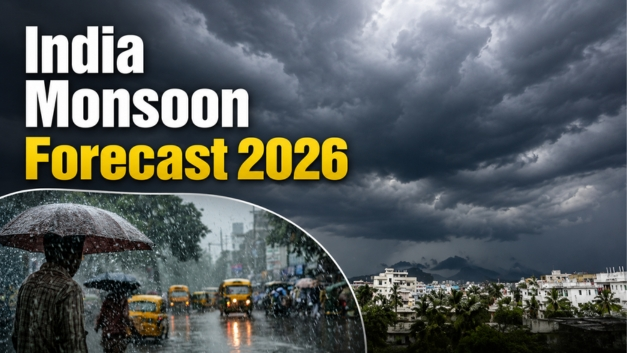
Indian Monsoon Forecast 2026: The lifeline of India’s agricultural economy, the Southwest monsoon, is entering a highly erratic phase. Both the India Meteorological Department (IMD) and private forecaster Skymet Weather have issued their comprehensive outlooks for the 2026 monsoon season (June to September). As climate indicators tilt toward extreme patterns, the state-wise and region-wise distribution presents a starkly divided picture for the subcontinent.
Understanding the National Forecast: The El Niño Factor
Quantitatively, the IMD has predicted the 2026 seasonal rainfall to be below normal, pinning it at 92% of the Long Period Average (LPA). Concurrently, Skymet Weather released a similar projection, estimating the monsoon at 94% of the LPA. The historical baseline for national seasonal rainfall stands at 87 cm.
The primary catalyst driving this subpar rainfall projection is the rapid formation of a potentially historic El Niño event in the equatorial Pacific Ocean. The transition from previous weak La Niña conditions to an ENSO-neutral phase is progressing far quicker than usual, leading meteorologists to warn of a strong El Niño presence that will likely peak during the latter half of the season.
Region and State-Wise Monsoon Distribution for 2026
The national averages mask profound geographical disparities. The 2026 monsoon will be heavily localized, presenting severe dryness in core agricultural zones alongside intense, localized deluge risks along eastern and southern belts.
North India: Prolonged Dry Spells
Northwest India faces a heightened probability of deficit precipitation, particularly during the critical months of August and September.
- Highest Risk States: Punjab, Haryana, Delhi-NCR, and Western Rajasthan.
- Weather Outlook: The region will experience intense, lingering summer heat waves with minimal monsoon relief. Drier and hotter conditions are highly likely to extend well into late September.
West and Central India: Vulnerable Crop Belts
The core monsoon rainfed belt across central and western states is expected to struggle with inadequate precipitation.
- Affected States: Gujarat, Maharashtra, and Madhya Pradesh.
- Specific Risk Zones: Deep pockets of Madhya Pradesh including Indore, Ujjain, Gwalior, and Jabalpur are projected to see substantial rainfall deficits. This triggers serious concerns for early-stage Kharif crop sowing.
East and Northeast India: Relatively Stable Showers
In stark contrast to the rest of the country, the eastern wing is expected to perform remarkably better, buffered by localized atmospheric conditions.
- Key States: Assam, Meghalaya, Arunachal Pradesh, Bihar, Jharkhand, and West Bengal.
- Weather Outlook: Early onset trends showcase heavy to very heavy rainfall across Sub-Himalayan West Bengal, Sikkim, and Assam. The overall season is anticipated to remain near normal to above normal.
South Peninsular India: Early Onset and Flood Alerts
The southern peninsula is tracking a significantly accelerated weather timeline due to warm trade wind configurations.
- Early Onset: The official onset over Kerala is tracked for May 26, 2026, advancing roughly five days ahead of the traditional June 1 timeline.
- The Flood Threat: While the interior peninsula faces mixed trends, coastal Tamil Nadu (including Chennai) and Kerala face an elevated risk of excessive rainfall, storm surges, and severe urban flooding, a pattern highly consistent with severe El Niño cycles.
The Saving Grace: Will the Indian Ocean Dipole Save the Kharif Season?
While the brewing El Niño signals an alarming climate trend, meteorologists are closely monitoring the Indian Ocean Dipole (IOD). Current observations show a neutral IOD, but predictive climate models indicate that a positive IOD phase is highly likely to develop toward the tail-end of the monsoon season.
A strong, positive IOD causes warmer sea surface temperatures in the western Indian Ocean near Africa. This temperature shift increases moisture content in the monsoonal winds hitting the Indian mainland, acting as an atmospheric buffer. If the positive IOD gains strength quickly enough, it could partially offset the drying effects of El Niño, rescuing late-season crops and refilling crucial groundwater reservoirs across Central India.
Must read, 2026 Mega Highway Projects in India: Tunnels, Roads and Bridges
Watch Latest News Videos on KRH News: Click Here