


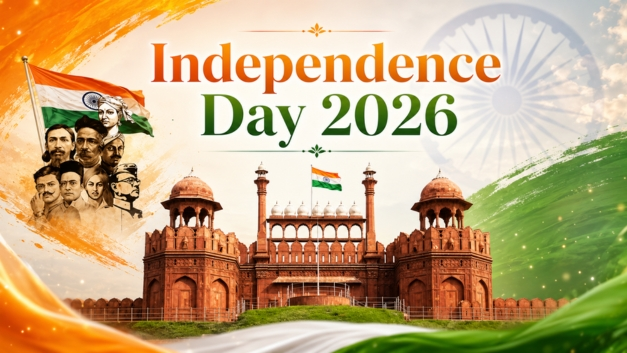
Independence Day 2026: Every year on August 15, the Indian nation comes together in a magnificent display of patriotism to commemorate its freedom from nearly two centuries of British colonial rule. In 2026, India celebrates its historic 80th Independence Day, marking eight decades of democratic governance, socio-economic progress, technological breakthroughs, and nation-building.
From the iconic ramparts of the Red Fort in New Delhi to remote rural Panchayats, millions unfurl the Tricolor to honor the sacrifices of freedom fighters and reaffirm their commitment to a self-reliant, developed nation (Viksit Bharat).
Historical Significance: The Long March to August 15, 1947
India’s journey to independence was a monumental struggle characterized by supreme sacrifice, non-violent resistance, and revolutionary courage.
1. The Early Resistance
The seeds of national liberation were sown during the First War of Independence in 1857 (Sepoy Mutiny). Over the following decades, intellectuals, social reformers, and revolutionaries laid the foundation for an organized political fight against colonial exploitation.
2. Mass Movements Under Mahatma Gandhi
Under the leadership of Mahatma Gandhi, the Indian National Congress mobilized millions across cities and villages through mass non-violent campaigns:
- Non-Cooperation Movement (1920): Challenged British economic and educational hegemony.
- Civil Disobedience Movement & Salt March (1930): Defied unjust British taxation and monopoly laws.
- Quit India Movement (1942): Sent an unequivocal message demanding immediate British withdrawal from India.
3. Revolutionary Valor & Global Pressure
Alongside Gandhian Ahimsa, freedom fighters like Subhas Chandra Bose (and his Azad Hind Sena), Bhagat Singh, Chandrashekhar Azad, and Rani Lakshmibai inspired the youth. World War II severely weakened the British Empire, compelling Lord Mountbatten to execute the transfer of power on August 15, 1947. At midnight, Independent India’s first Prime Minister, Jawaharlal Nehru, delivered his legendary “Tryst with Destiny” address.
Why 2026 Holds Special Importance: The 80th Milestone
The 80th Independence Day in 2026 is not merely a ceremonial anniversary; it represents a strategic bridge between past accomplishments and future aspirations.
- Strategic Progress Toward Viksit Bharat 2047: With the centenary of Indian independence approaching in 2047, 2026 marks a crucial midpoint for national targets in digital infrastructure, green energy transition, and economic expansion.
- Technological & Space Leadership: Highlighting India’s global achievements in space exploration, indigenous AI deployment, and defense self-reliance (Aatmanirbhar Bharat).
- Youth & Women-Led Development: Emphasizing youth entrepreneurship, digital inclusion, and empowering women leaders across governance and industry.
Lesser-Known Facts About August 15
- Why August 15? Lord Mountbatten chose August 15 because it coincided with the second anniversary of Japan’s surrender in World War II (August 15, 1945).
- Five Other Nations Share the Date: Liechtenstein, Bahrain, Republic of the Congo, South Korea, and North Korea also celebrate their independence or national liberation on August 15.
- The National Flag Code: The Indian Tricolor must always be made of hand-spun Khadi or specified silk/polyester fabrics, with the Ashoka Chakra featuring 24 spokes representing continuous progress.
- No National Anthem at Midnight: When India became independent at midnight on August 14–15, 1947, “Jana Gana Mana” was not yet officially adopted as the National Anthem (it was officially declared in 1950).
How Independence Day Is Celebrated Nationwide
From government institutions to neighborhood communities, the celebration unites over 1.4 billion people:
- Red Fort Ceremony: The Prime Minister hoists the national flag, followed by the National Anthem, a 21-gun salute, an aerial flypast by the Indian Air Force, and the annual presidential address to the nation.
- State & District Celebrations: Chief Ministers hoist the Tricolor in state capitals, accompanied by police parades and cultural performances.
- Schools and Colleges: Educational institutions host flag hoisting, essay contests, patriotic song renditions, and drama performances celebrating national heroes.
- Kite Flying Tradition: In northern cities like Delhi, Jaipur, and Amritsar, the skies are filled with thousands of colorful kites symbolizing freedom and joy.
Frequently Asked Questions (FAQ)
Who hoists the flag at the Red Fort on August 15?
The Prime Minister of India hoists the National Flag at the Red Fort on Independence Day. (Note: On Republic Day, January 26, the President unfurls the flag at Kartavya Path).
What is the national vision connected with Independence Day 2026?
The nation continues its strategic march toward Viksit Bharat 2047, aiming to transform India into a fully developed nation by its centenary of independence.
Also read, August 2026 Festivals and Days: Complete Calendar
Watch Latest News Videos on KRH News: Click Here