


Women Risk Lives for Water in Gujarat’s ‘Cherrapunji’ as Government Schemes Fail
Valsad Water Crisis: While the Gujarat government continues to echo massive claims of delivering ‘Nal Se Jal’ (water from every tap) to homes across the state, a shocking and heart-wrenching reality from the tribal-dominated Kaprada taluka of Valsad district has shattered these developmental narratives.
The Alarming Daily Grind at Moti Palsan’s 45-Foot Wells
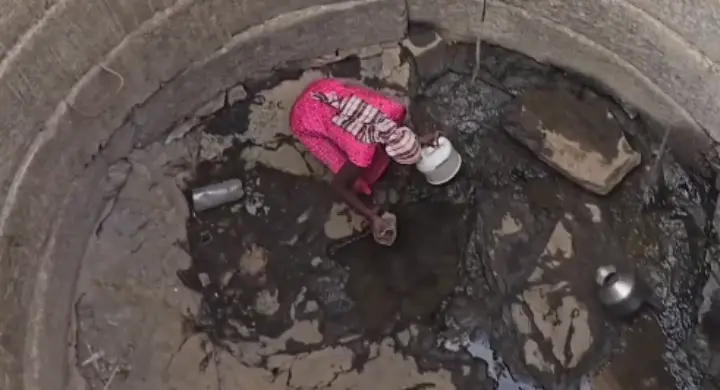
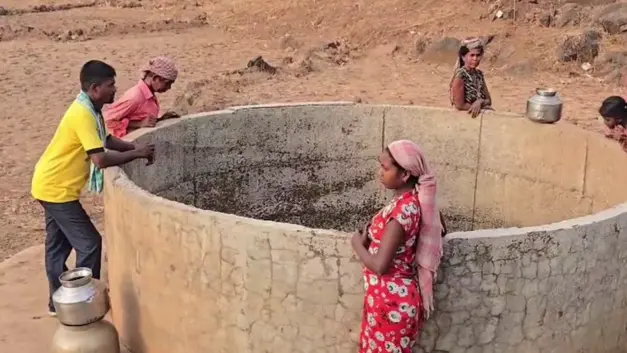
Moti Palsan village, a location ironically situated in a region with some of the highest monsoon rainfall in the state, is often referred to as Gujarat’s ‘Cherrapunji’. During the searing peak summer, this very village is left parching. In the Berasta Faliya (sub-locality) of Moti Palsan, women are forced to risk their lives daily, descending into a 45-foot-deep dry well to fetch even a single pot of water.
1200 Lives, Zero Functioning Water Sources in Berasta Faliya
The crisis in Berasta Faliya is catastrophic. The area, home to nearly 1,200 residents, officially lists eight government-installed wells. However, as the temperature rises, every single one of these wells dries up completely.
Modus Operandi for Survival:
- The Descent: With no functioning surface level water, villagers have descended into extreme measures. In one well, women and men use an internal iron ladder and ropes to lower themselves 45 feet down.
- The Struggle for Scraps: When the ladder isn’t available, they cling to dangerous internal iron support rods to access the rocky crevasses far below.
- Collecting by the Teaspoon: As groundwater barely seeps into small cracks and crevices along the well’s bottom, residents patiently wait and collect this minimal seepage cup by cup, slowly filling their brass pots.
- Frequent Accidents: Local residents, including Umesh Vagh and Dhirubhai Madh, report that this daily struggle often ends in tragedy. In the rush for water, women regularly lose their footing along the slippery well walls, sustaining severe, sometimes critical, injuries from falls.
Key Community Voices and Eyewitness Testimonies:
“We fight a war every day for a single bucket of water. Our families cannot survive without it, and we are forced to watch our children endure this while we risk our lives.” – Umesh Vagh, Berasta Faliya Local.
1 to 2 Hours Wait for a Single Pot
This is not a temporary inconvenience; it is a full-scale assault on daily life in Moti Palsan. The water crisis in Kaprada, which begins almost immediately after winter and persists until the monsoon breaks, has halted normal family life.
Women arrive at the well edge at the first light of dawn, joining an agonizingly long queue. Due to the minimal seepage, it can take an entire family one to two hours just to fill one or two pots. Many mothers are forced to bring their young, innocent children with them, who are then exposed to the brutal, direct summer sun for the entire day.
Astol Group Water Supply Scheme: A ₹586 Crore Ghost in the Machine
The most egregious failure in this crisis is systemic. The extensive tribal regions of Kaprada and Dharampur were supposed to be the beneficiaries of the massive, ambitious ₹586 Crore ‘Astol Group Water Supply Scheme’.
Under this scheme, new Nal Se Jal taps and intricate pipeline networks were indeed installed directly in the homes and lanes of Moti Palsan village. Yet, residents testify that to date, not a single drop of water has ever flown through these taps.
Due to criminal negligence by the administrative bodies, the pipelines that were laid without ever being used have already begun to decay, rot, and fall apart under the ground before ever serving a single user. The millions of gallons of water that pour into this region’s reservoirs during monsoon are mismanaged and lost, leaving Gujarat’s ‘Cherrapunji’ residents struggling to survive in the summer heat.
Also read, Valsad Mango Farmers Hit Hard as Gulf Export Demand Declines
Watch Latest News Videos on KRH News: Click Here